
 Vibration isolation
AMC acoustic ceiling and wall mounts
AMC ceiling and wall mounts work together with resilient Sylomer® pads. The mount connects the structures, while the pad inside helps reduce vibration passing from one to the other.
Voller is AMC Mecanocaucho’s factory representative in Estonia.
We keep most of the range in stockPlease check availability for your model and quantity.
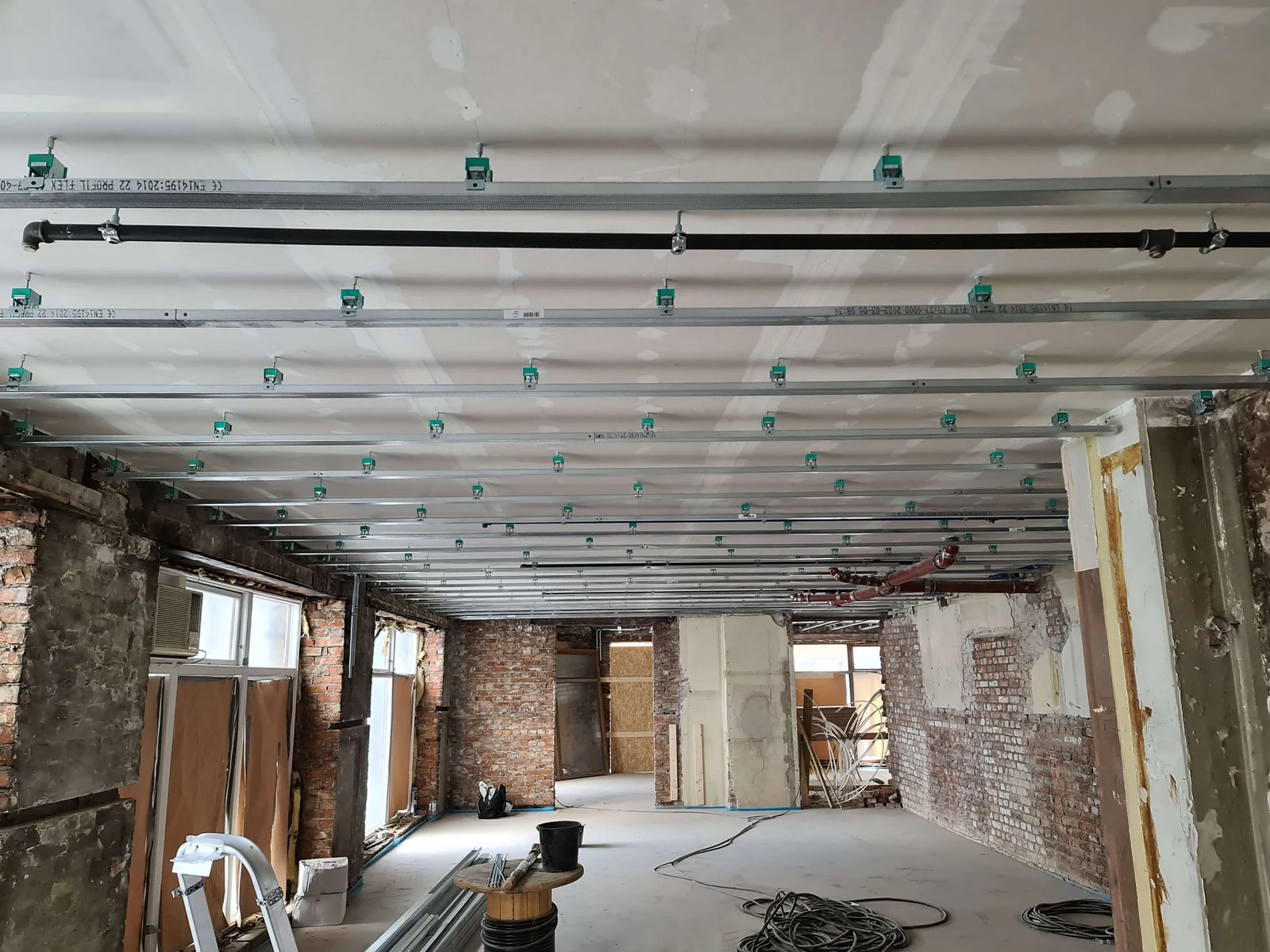
Less vibration through the connection
The mount and its Sylomer® pad work together. The metal part connects the structures, while the resilient polyurethane pad reduces vibration passing through the connection. The pad must be selected to suit the load at that fixing point.
Rigid connection
Existing load-bearing structure
Rigid fixing
Ceiling framework and board lining
Vibration can travel through the fixing into the ceiling framework and lining.
Resilient Sylomer connection
Existing load-bearing structure
Sylomer-isolated fixing
Ceiling framework and board lining
The resilient element reduces vibration transmission through the connection. It does not eliminate transmission completely.
Simplified principle diagrams, not installation drawings. Arrow sizes do not represent measured performance.
For ceilings, walls and equipment
Three different installation points call for three different solutions.
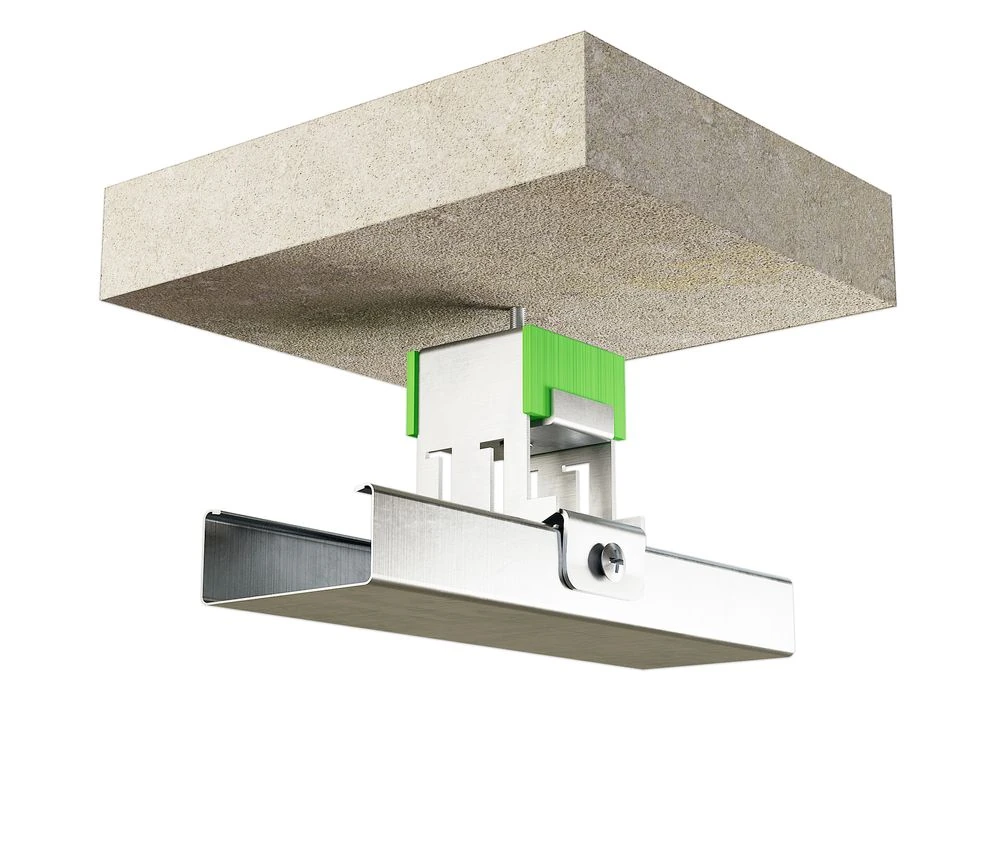
AKUSTIK SUPER T60 + Sylomer®
A ceiling mount with a Sylomer® pad for compatible 60 mm profiles. Available in 15, 30, 50 and 75 kg load variants; selection depends on the actual load per mount.
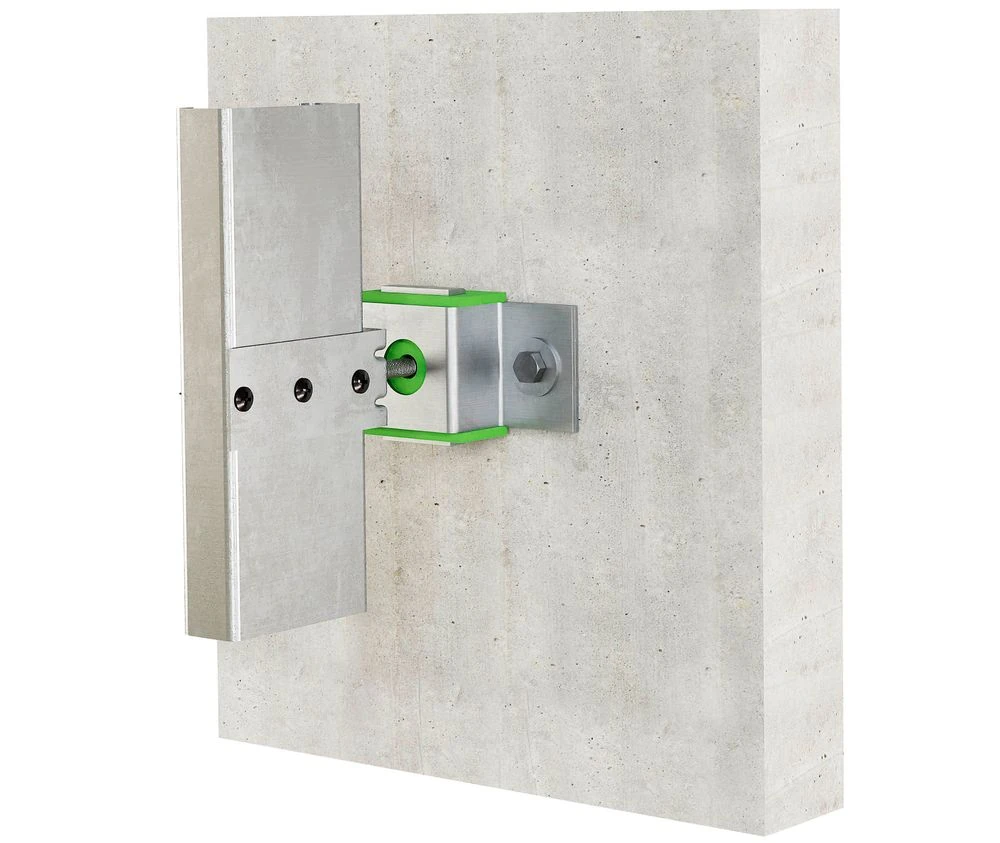
EP 400 + Sylomer®
A resilient wall tie connecting plasterboard framing to an existing wall. Sylomer reduces vibration transmission between the wall and framing.
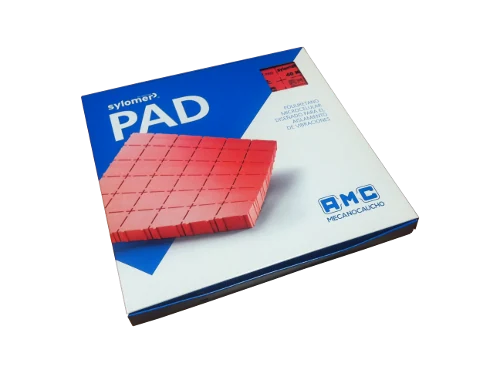
Sylomer® PADs
Cuttable resilient pads for equipment and suitable support points. Material grade, loaded area, thickness and load all matter.
Resiliently connect the ceiling to the structure
Acoustic mounts support a resiliently suspended plasterboard ceiling. Applications include ceilings beneath apartment or hotel floors, timber floor refurbishment and rooms with demanding acoustic requirements. The right assembly depends on the noise source and the complete ceiling construction.
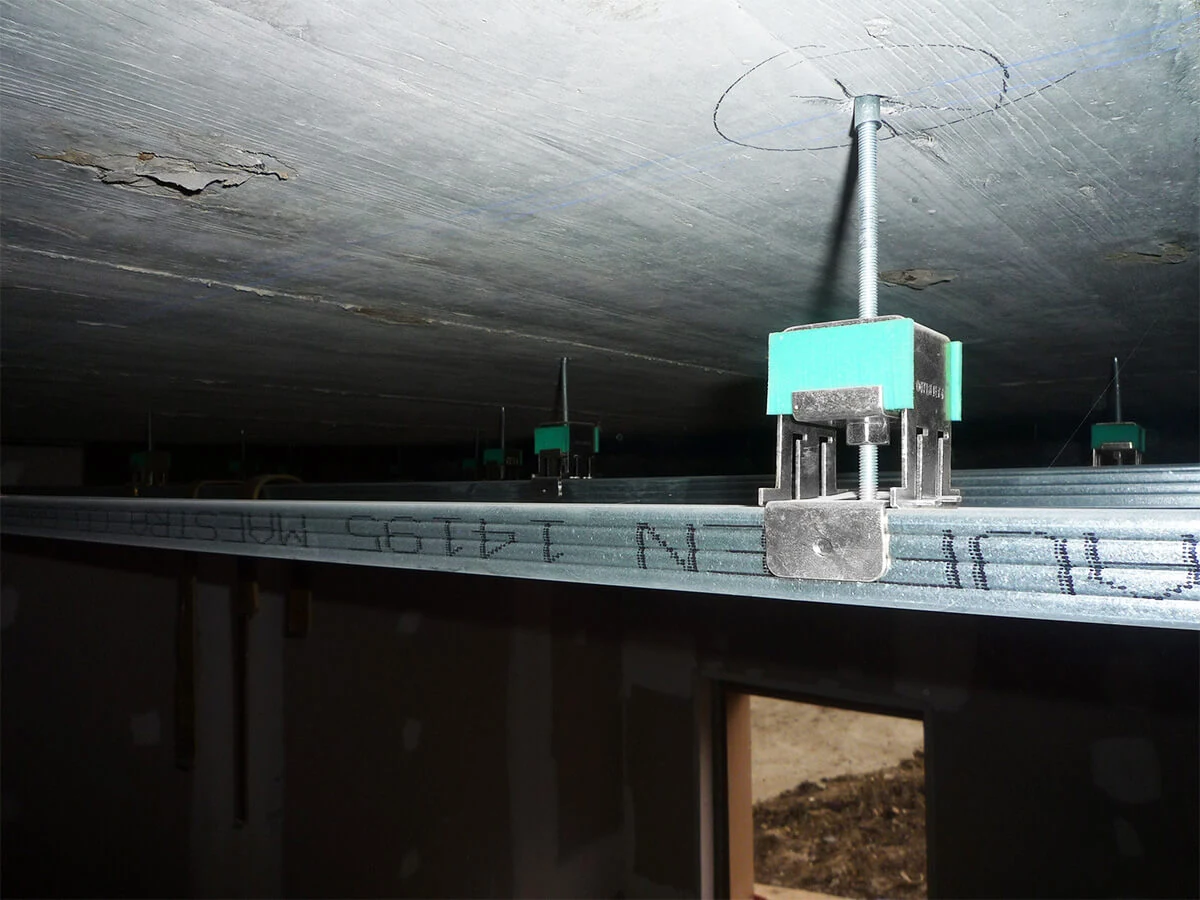
T60: suspended profile framework
AKUSTIK SUPER T60 + Sylomer® fits compatible 60 mm ceiling profiles. Its resilient element is located between the load-bearing structure and the ceiling framework. Select the fixing variant and M6 or M8 connection for the project.
- Example: a plasterboard ceiling with adjustable suspension height.
- Check profile compatibility and the distribution of suspension points.
- Include the total mass of boards, framework, insulation and other components supported by the mounts.
EP 400 + Sylomer® for wall framing
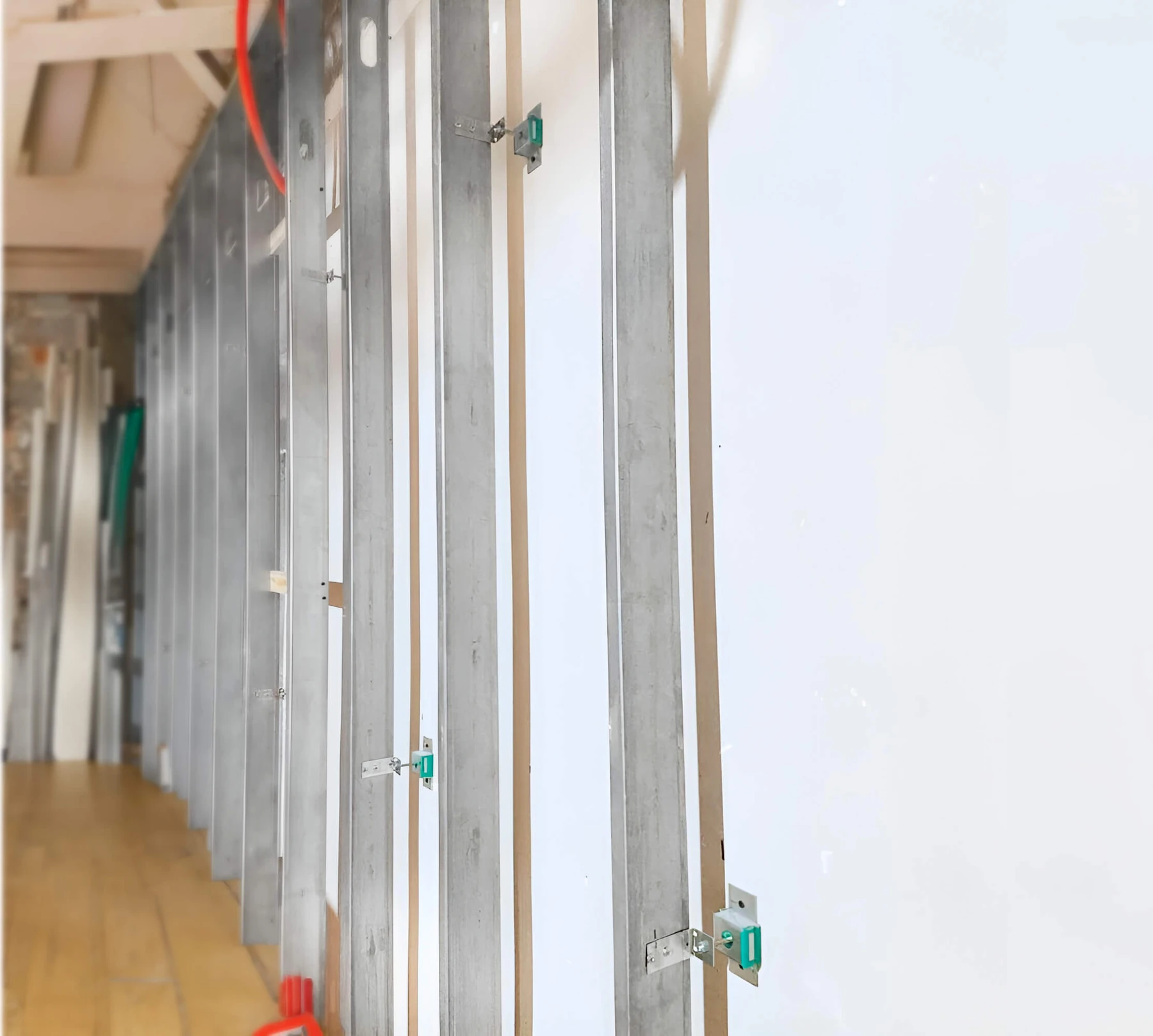
When a new plasterboard wall is built in front of an existing wall, the connections matter too. Rigid fixings can pass vibration from the existing wall into the new framing. EP 400 connects the framing to the wall through a resilient Sylomer pad.
- Fix EP 400 to the existing wall.
- Connect its L-shaped bracket to the vertical framing profile.
- Fix the plasterboard to the framing.
Important: EP 400 is a lateral wall tie and does not carry the wall’s weight. Vertical loads must be supported separately at floor level, as specified in the design.
Vibration isolation at a loaded support point
Pads can be placed under suitable equipment supports to reduce vibration transmission into the building. AMC lists ventilation and cooling equipment, compressors and other machinery as applications. A loose pad is not a substitute for a complete ceiling mount.
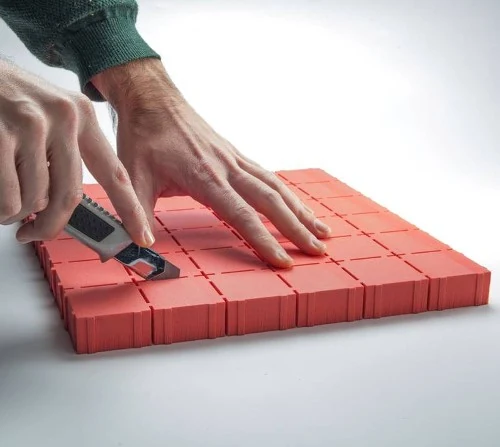
The load capacity depends on both the material grade and the loaded area. Cut and position the pieces according to the load at each support; thickness affects deflection and vibration isolation characteristics.
| Material / PAD | Colour | Manufacturer max. load* |
|---|---|---|
| PAD 110 | Brown | 20 kg / piece |
| PAD 220 | Red | 40 kg / piece |
| PAD 450 | Grey | 80 kg / piece |
| PAD 850 | Turquoise | 120 kg / piece |
| PAD 1200 | Wine red | 160 kg / piece |
* AMC product-table values for a standard PAD element, not an arbitrarily sized cut piece or a whole sheet. AMC lists 12 and 25 mm thicknesses. Check final dimensions, number of pieces and loading against the technical data sheet.
Colour identifies a variant. Read what its number means.
A complete mount load variant and a Sylomer material grade are different designations. They must not be interpreted as one common kilogram scale.
T60 mount colours and loads
| Colour in AMC data sheet | Mount variant | Max. load |
|---|---|---|
| Pink | 15 | 15 kg |
| Turquoise green | 30 | 30 kg |
| Dark green | 50 | 50 kg |
| Bright green | 75 | 75 kg |
These are maximum loads per T60 mount. Selection must also account for the suitable working load, not just the upper limit. This table does not apply to EP 400 wall ties.
Two different numbering systems
T60 + Sylomer® 30
T60 identifies the model; 30 indicates a maximum load of 30 kg for that mount variant. M6/M8 refers to the thread size.
PAD 110
PAD 110 does not mean 110 kg. The number relates to the Sylomer material grade; the AMC table gives 20 kg per standard PAD 110 element.
Start with the construction, not the colour
Where will it be installed?
Concrete or timber, ceiling or wall, profile type and required installation height determine the fixing.
What is the actual load?
For a ceiling, establish the total mass per square metre and the area supported by each mount. For equipment, account for the actual load distribution between supports.
What needs to be isolated?
Describe the noise or vibration source. Suitability depends on the working load, vibration frequency and installation.
×
=
Example: 30 kg/m² × (0.6 m × 0.9 m) = 16.2 kg. This explains the load calculation; it does not specify mount spacing or select a model. Framework, anchors and fixings must be designed for the project.
Keep the resilient connection resilient
Avoid rigid bypasses
An incorrectly positioned screw, threaded rod or metal contact can create a rigid path around the resilient element.
Check edges and penetrations
Contact with adjoining structures and penetrations for pipes and cables must be detailed as part of the complete assembly.
Distribute the load correctly
Mount spacing, quantity and supporting profiles must follow the design. Do not add or remove mounts solely on acoustic grounds.
Follow the instructions for the model
The correct anchor, screw, connection method and resilient element working range are as important as the mount itself.
Questions before ordering
Do these products absorb room reverberation?
Their main purpose is to reduce vibration transmission through connections. Sound-absorbing finishes address reverberation; these are different tasks.
Is the mount with the highest number the best?
No. The mount must match the load at its fixing point and the vibration characteristics. Maximum load capacity alone is not a sufficient selection criterion.
Does PAD 110 support 110 kilograms?
No. The number relates to the material grade. AMC lists a maximum load of 20 kg per standard PAD 110 element.
We can help you choose the right product
Send a drawing, photo or short description of what you are building and the vibration you want to reduce. If you know the construction weight, profile type or quantity, include those too. You do not need to calculate every technical detail before contacting us.
Send drawings and files by email.
We keep most of the range in stock. Please check availability for your model and quantity.